

Jersey Identity & Team Design
Dallas wore white. Baltimore wore purple. Both decisions were made decades before kickoff, and in completely different ways. When the Cowboys and Ravens met at the Maracanã in Rio de Janeiro on Sunday, they put two of the NFL's most identifiable uniforms on one field — one that has barely moved since 1964, and one that was rebuilt from scratch this spring.
The game is already history: Baltimore won 34–31 on a 56-yard field goal with one second left. The uniforms are the part worth studying, because they show two franchises solving the same problem — how does a team become recognizable? — with opposite methods.
Dallas answered the question once, in 1964
The Cowboys have never really had a second act. When the franchise debuted in 1960 it wore a white helmet with a simple blue star, blue jerseys with a small blue star on each shoulder at home, and the reverse on the road. The star was not decoration; it was Texas, the Lone Star State, doing the entire job of identifying the team.
Then came 1964, the year everything that still matters was decided. The helmet went silver-blue. The star gained a white border so it would lift off the shell. The shoulder stars were deleted. And the pants picked up the helmet's blue-white-blue striping.
The star got one more revision, in 1967, when a blue outline was added around the white border. That is the last genuine logo change the franchise has made. Everything since is refinement — wider sleeve stripes in 1966, numbers sliding from shoulder to sleeve between 1970 and 1973, a darker blue in 1981.
Dallas did not arrive at a distinctive identity by winning a long series of design arguments. It arrived there by stopping having them.
The boldest thing Dallas ever did was refuse to pick a color
In 1964 the NFL began permitting teams to wear white at home, and Dallas never stopped. It is the most consequential choice in the franchise's visual history, and it was not an aesthetic one.
Team president Tex Schramm said he wanted home fans to see opponents' colors. Decades later, longtime Cowboys scout Gil Brandt told the Associated Press the blunter reason: the arrangement put the visiting team on the sunny side of the field while Dallas sat in the shade.
The consequence is structural. At a Cowboys home game the visitor supplies the color, which makes this the only uniform tradition in the league that routinely decides what the other team is wearing. It decided Rio. Dallas was the designated home team and wore white, so Baltimore had to wear purple — one of just two road games all year in which the Ravens appear in color.
The scale is easy to measure. Dallas published its 2026 uniform schedule in September, and the Cowboys wear white in some form — the primary white set or the all-white “Arctic” alternate — in 13 of their 17 games. Navy appears three times, the 1960s throwback once.
One more detail explains something fans notice without being able to name it. The white jersey's numbers are royal blue, the road jersey is a darker blue, and neither matches the silver-blue helmet. Dallas has had sixty years to reconcile the three and has declined.
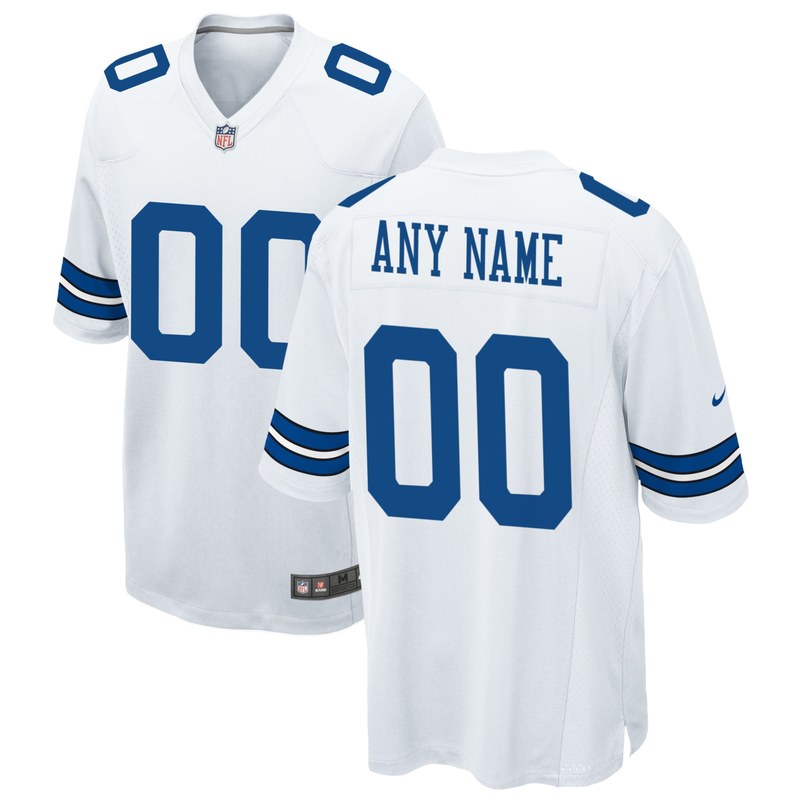
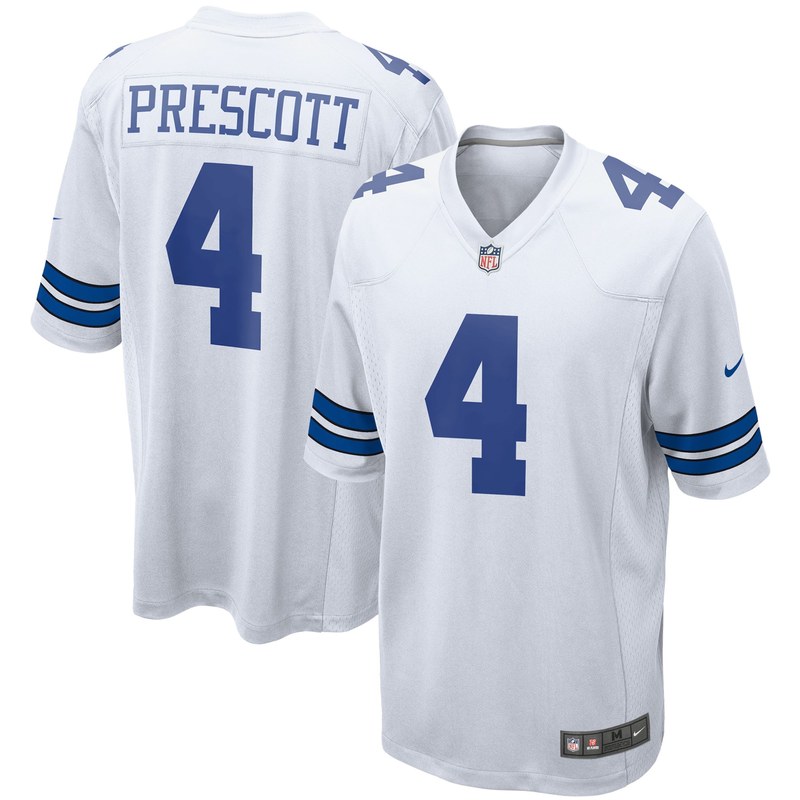
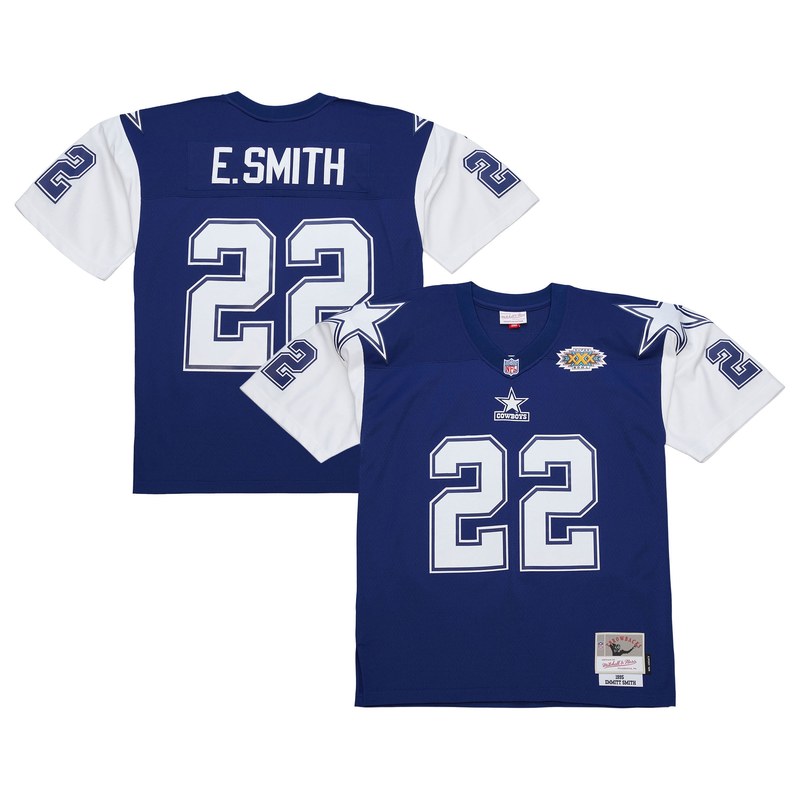
White, navy blue and silver. The primary home jersey is white with royal blue numbers, worn with a metallic silver-green pant and a silver-blue helmet carrying a blue star with a white border and a blue outline. The road jersey is navy — the one fans call the “Stars and Stripes” jersey — with white lettering trimmed in navy pinstripes. Since 1964 the Cowboys have worn white at home by choice, not by rule.
The blue jersey Dallas has spent five decades avoiding
If white is Dallas's identity, navy is its superstition. In blue jerseys the Cowboys have a losing regular-season record, and in the playoffs they are 2–6.
The story has a starting point. At the end of the 1968 season the blue-shirted Cowboys were badly upset by Cleveland in the divisional round — Don Meredith's last game as a Dallas quarterback. Two seasons later, designated home team for Super Bowl V, Dallas was obliged to wear blue and lost to the Colts.
The blue has produced exactly two playoff wins, in the 1978 NFC Championship and the 2022 wild card round. Design consequences follow superstition: a color a franchise avoids stops being a primary and becomes a road option, which is what happened to navy.
Dallas Cowboys jerseys in stock
3 jerseysWhite at home since 1964 — navy as the road option.
Baltimore never got to choose
Dallas chose white in a meeting. Baltimore did not get a meeting.
When Art Modell moved the franchise out of Cleveland after the 1995 season, the city of Cleveland sued for the right to keep the Browns' name, colors and history. Cleveland won. There would be no “Baltimore Browns,” and no inherited palette arrived with the moving trucks.
Into that gap went a poem. The name came from Edgar Allan Poe's “The Raven” — Poe lived in Baltimore and died there in 1849 — and the colors, by Modell's own admission to ESPN, were borrowed from the Northwestern Wildcats' 1995 season: purple, black, metallic gold, white. Baltimore's identity was assembled under legal pressure, out of a nineteenth-century poem and a college football team.
A security guard's fax that killed the first logo
The original Ravens mark, used from 1996 through 1998, was a winged shield with a large B at its center and a cross bottony beneath — heavy heraldry, with the Maryland flag doing the lifting.
It did not survive a fax machine. Frederick Bouchat, a Maryland security guard and amateur artist, sent his own design to the Maryland Stadium Authority after learning Baltimore was getting a team. He was never credited. He sued, a jury found the team had infringed his copyright, and the Fourth Circuit upheld the verdict. Bouchat collected no money, but he effectively got the logo.
The replacement was unusually democratic. The Baltimore Sun published three candidates and fans chose a raven's head in profile. Modell agreed, on the condition that a B appear somewhere in it; the letter went inside the bird's eye. That mark arrived in 1999 and has been on the helmet ever since.
Dallas Cowboys
Est. 1960 · White, navy, silver- Defining era: 1960–63, white helmet, a star on each shoulder
- The turn: 1964, one redesign that is still the uniform
- Frozen since: 1967, when the star got its outline
- Signature move: wearing white at home so the visitor brings the color
- 2026: white in 13 of 17 games, no redesign
Baltimore Ravens
Est. 1996 · Purple, black, gold- Defining era: 1996–98, a winged shield a lawsuit retired
- The turn: 1999, raven head with the B in its eye
- Rewritten: 2004, 2016, 2024 and again in 2026
- Signature move: building a new look out of its own archive
- 2026: two helmets, a new color, 12 combinations
What Baltimore changed this spring — and why it points backward
The 2026 Ravens uniform is called “The Next Flight,” unveiled April 16 at Merriweather Post Pavilion. It is the most significant change to the club's primary look in a generation — the first collection of its kind since the 1999 rebrand.
The primary helmet is untouched: black shell, purple talon stripes, the 1999 raven head. Around it the club added two alternates — a matte black “Darkness” helmet with a front-facing, two-toned raven and red eyes, worn only with the all-black set, and an updated “Purple Rising” helmet that trades the front-facing mark for the primary logo.
Then there is the color. “Midnight Purple” is engineered to shift: purple in light, nearly black in shadow, the way a raven's feathers behave. It now outlines every jersey number, fills the sleeve shields and runs down the talon stripes on every pair of pants, replacing the gold trim and drop shadow the numbers used to carry.
The rest is referential. The collar pattern is a raven's wings spread in a threat display, pulled from feather details in the original 1996 logo set. The pant stripes are cut on a diagonal to suggest talons, quoting the Calvert crest in the Baltimore and Maryland flags. The purple, black and purple-alternate jerseys read “Ravens” across the chest; the white road jersey reads “Baltimore” — the first time the city's name has appeared on any Ravens uniform.
The interiors are what fans will find last. Home and road collars carry “Play Like A Raven,” and the black alternate carries three words from Poe: Darkness there and nothing more — the line where the narrator opens his door and finds nothing but black.
| Year | Team | What changed |
|---|---|---|
| 1960 | Dallas | White helmet, blue star, a star on each shoulder |
| 1964 | Dallas | Silver-blue helmet and pants, bordered star, shoulder stars deleted |
| 1967 | Dallas | Blue outline added to the star — the last logo change |
| 1996 | Baltimore | Winged shield logo, purple and black, black pants |
| 1999 | Baltimore | Shield retired by lawsuit; raven head with the B in its eye |
| 2004 | Baltimore | All-black alternate introduced |
| 2016 | Baltimore | All-purple Color Rush with gold numbers |
| 2024 | Baltimore | The “Purple Rising” alternate helmet |
| 2026 | Baltimore | “The Next Flight”: two helmets, 12 combinations |
| 2026 | Dallas | Nothing — not among the five clubs that redesigned |
Baltimore Ravens jerseys in stock
3 jerseysPurple and black, rebuilt from zero in 1996.
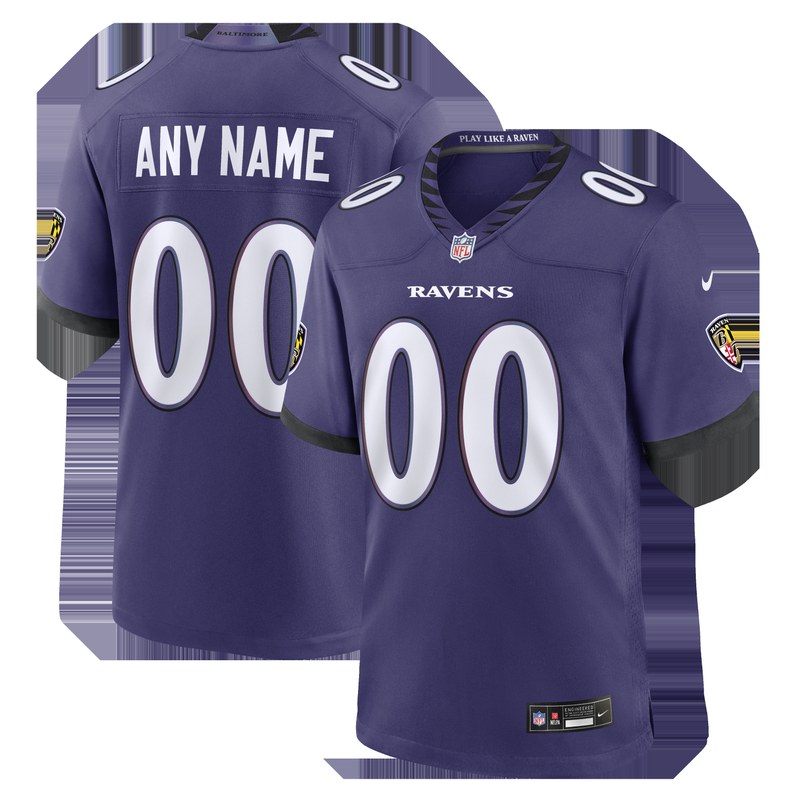
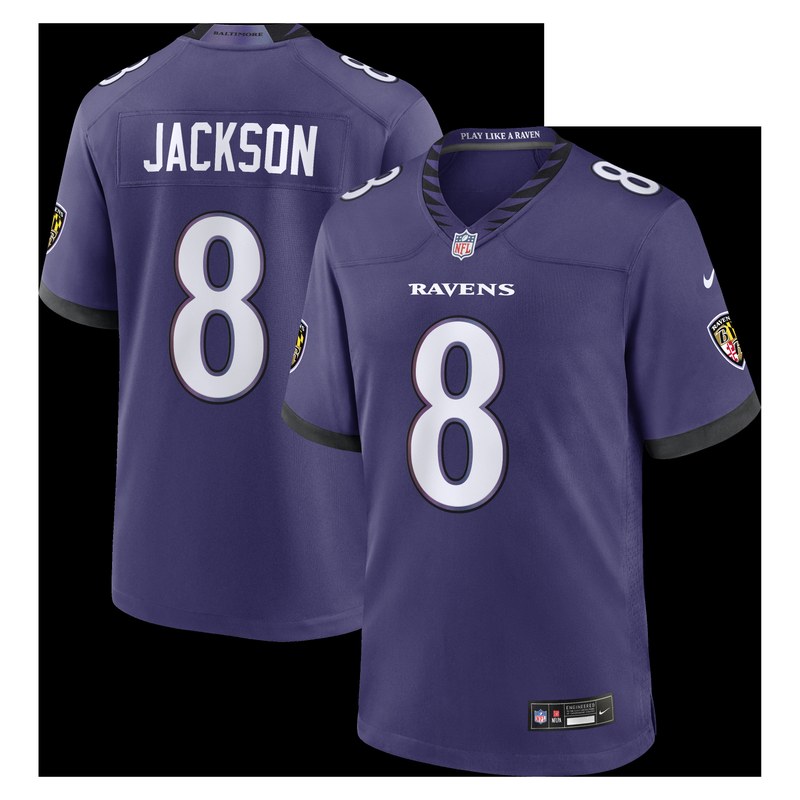
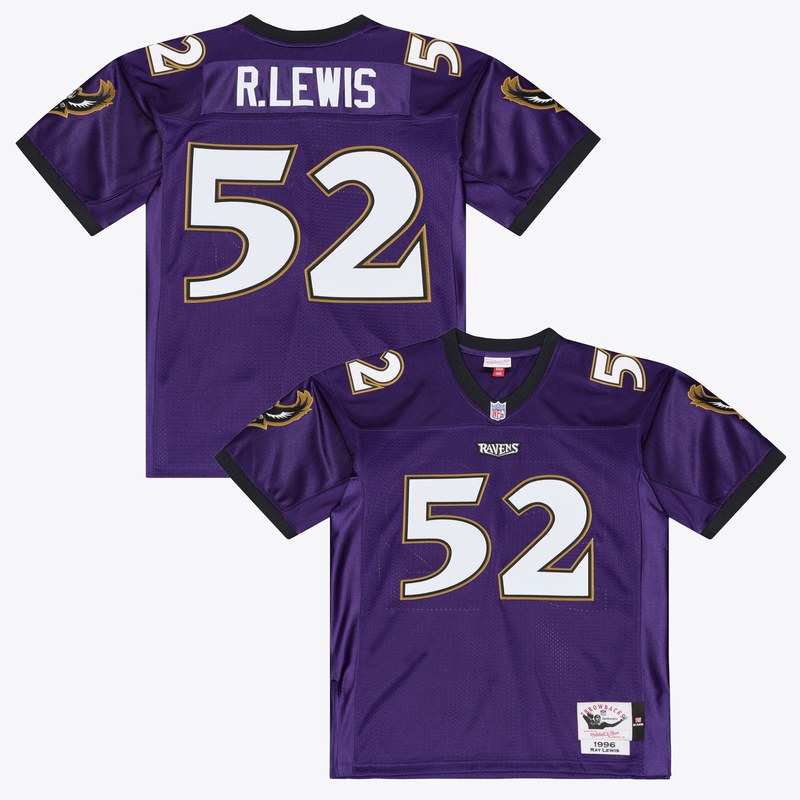
Ray Lewis 1996 Authentic Throwback Jersey · Purple
$83.99 $141.57
Two opposite routes to the same place
Dallas treats its uniform as a fixed platform. Nothing in the design invites an update, so none is made, and the brand does the work most teams ask a redesign to do. Baltimore treats its uniform as an archive. Each version cites an older one — the 2026 collar cites the 1996 logo, the palette cites a college season from 1995, the black alternate cites a poem published in 1845.
Rio made it visible in a single frame. Dallas wore a decision made in 1964; Baltimore wore a decision made in 1996. Only one of those decisions was still being designed this spring.
There is an irony in the rules. Because the Cowboys were the designated home team and wear white, Baltimore had to wear a contrasting color — so the Ravens appeared in Rio in the purple jersey reading “Ravens.” The one Ravens jersey that carries the word “Baltimore,” the first in franchise history, is the white road design, and a sixty-two-year-old Dallas preference took it off the table.
For the technical side of how those numbers get cut and assigned, see why NFL jersey numbers matter to football fans. For how the throwback business turned history into product, see why throwback NFL jerseys continue to stand out. And for the same two-team comparison applied to another pair, read Falcons vs. Packers: the jersey colors and team identities.
Quick answers
What colors do the Dallas Cowboys wear?
White, navy blue and silver. The primary home jersey is white with royal blue numbers, worn with a metallic silver-green pant and a silver-blue helmet carrying a blue star with a white border and a blue outline. The road jersey is navy with white lettering and navy pinstripes.
Why do the Dallas Cowboys wear white at home?
The tradition started in 1964, the year the NFL began permitting it. Team president Tex Schramm said he wanted home fans to see opponents' colors; longtime scout Gil Brandt later told the Associated Press the practical motive was that it forced visiting teams to sit on the sunny side of the field while Dallas sat in the shade.
Why did the Baltimore Ravens change their logo in 1999?
They lost a copyright case. The original 1996 logo, a winged shield with a B, was found to infringe a design submitted by Frederick Bouchat, a Maryland security guard who had faxed it to the Maryland Stadium Authority. The Ravens then let fans choose a replacement from three options; the winner was a raven's head in profile, with the B placed inside its eye.
What colors are the Baltimore Ravens?
Purple, black, metallic gold and white, with purple as the primary. According to owner Art Modell, the palette was inspired by the Northwestern Wildcats' 1995 season. The 2026 “Next Flight” collection added a shifting shade the team calls Midnight Purple.
Uniform details follow the clubs' own announcements and league records of uniform, helmet and supplier changes.