

Jersey Colors & Team Identity
Thursday night at Lambeau Field puts two of the NFL's most recognizable color schemes on the same field — and they could hardly be more different in how they got there. The Green Bay Packers have worn essentially the same green, gold and white uniform since 1961. The Atlanta Falcons have kept the same three colors since 1966 and changed which one leads at least four times.
That contrast is the real story: one franchise treats its uniform as a fixed asset to be defended, the other as a design brief re-answered every decade.
Green and white: what the color split actually means
On Thursday the Packers are at home, which means they name the color, and the Falcons supply the contrast. Atlanta's white road jersey is therefore not a stylistic choice so much as the structural answer to Green Bay's dark green — the home club declares its shirt, and the visitor has to be visibly different.
Wearing white on the road is close to universal in the NFL, but the Packers are among the least likely clubs to break the convention: they have worn white at home exactly twice, across the opening two games of the 1989 season. Almost every other Sunday in Green Bay is dark green or nothing.
Green Bay Packers
Est. 1919 · Green & gold- Defining era: 1919–1949 in navy blue and gold, borrowed from Notre Dame
- The turn: 1950, when a new head coach insisted the team be its color
- Frozen since: 1961 — same green, same stripes, same helmet logo
- Signature move: refusing to change when everyone else did
Atlanta Falcons
Est. 1966 · Black, red & silver- Defining era: a new leading color roughly every decade
- The turn: 2026, returning red to the primary home jersey
- Rewritten: 1971, 1978, 1990, 1997, 2003, 2020 and 2026
- Signature move: keeping the palette and re-deciding its proportions
Green Bay: one decision, defended for sixty-five years
The Packers did not start green. Founder Curly Lambeau, a Notre Dame alumnus, borrowed the school's navy blue and gold, and the club's earliest uniforms came from a local meat-packing company — Indian Packing paid for the gear on the condition that the team take its name. When Acme Packing absorbed the company, the franchise spent its first NFL season with “ACME PACKERS” printed across the chest. Early press called them the Bays, or simply the Blues.
Green arrived in 1950, and it arrived as a statement. New head coach Gene Ronzani dropped the navy and introduced green jerseys with gold numbers, explaining the change with a single line: we are the Green Bay Packers. The shade was refined into the darker hunter green by 1958 — the color the club still uses. Around the same period, in 1951, the Packers retired leather headgear for the metallic gold plastic helmet that has been theirs ever since.
The template that made the identity permanent arrived with Vince Lombardi. Taking over in 1959, he settled on forest green or white jerseys with metallic gold pants and contrasting stripes repeated across the helmet, sleeves and socks — a device so effective that other clubs copied it wholesale.
Then, in 1961, the helmets finally got a logo. Lombardi asked equipment manager Gerald “Dad” Braisher for a design; Braisher handed the job to his assistant, a St. Norbert College art student named John Gordon. What came back was a football-shaped letter G. It is the only logo that has ever appeared on a Packers helmet, and it has not changed in more than six decades.
It stands for Green Bay. A widely repeated claim that it means “greatness” is not supported by the team's records — both the Packers and the club's Hall of Fame archivist have said there is nothing in their history to suggest it. The Packers hold the trademark and have granted limited permission for similar marks to the University of Georgia and Grambling State, whose versions are distinct designs in their own colors.
What makes the Packers unusual is how actively that continuity has been maintained. In 1993 general manager Ron Wolf considered tinkering with the color scheme and dropped the idea. In 1994 the club joined the league-wide throwback program for the NFL's 75th anniversary, then returned to navy for Thanksgiving games in 2001 and 2010 — brief trips into the archive, not changes of direction. And in 2012, when Nike replaced Reebok as the league's supplier and most clubs accepted part of the new template, Green Bay declined essentially all of it. A team that owns its own history does not need to borrow anyone else's.
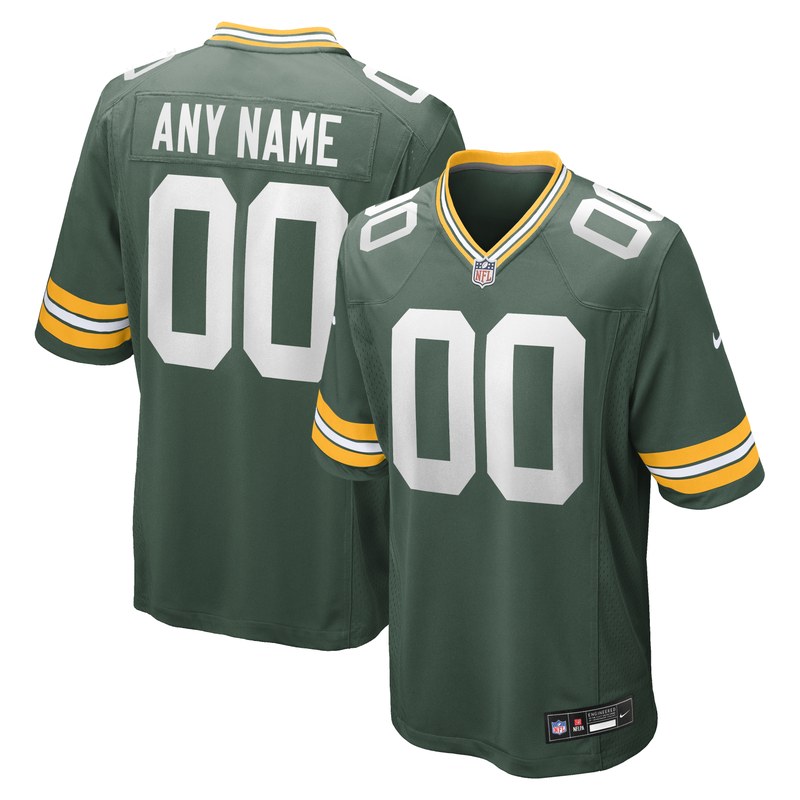
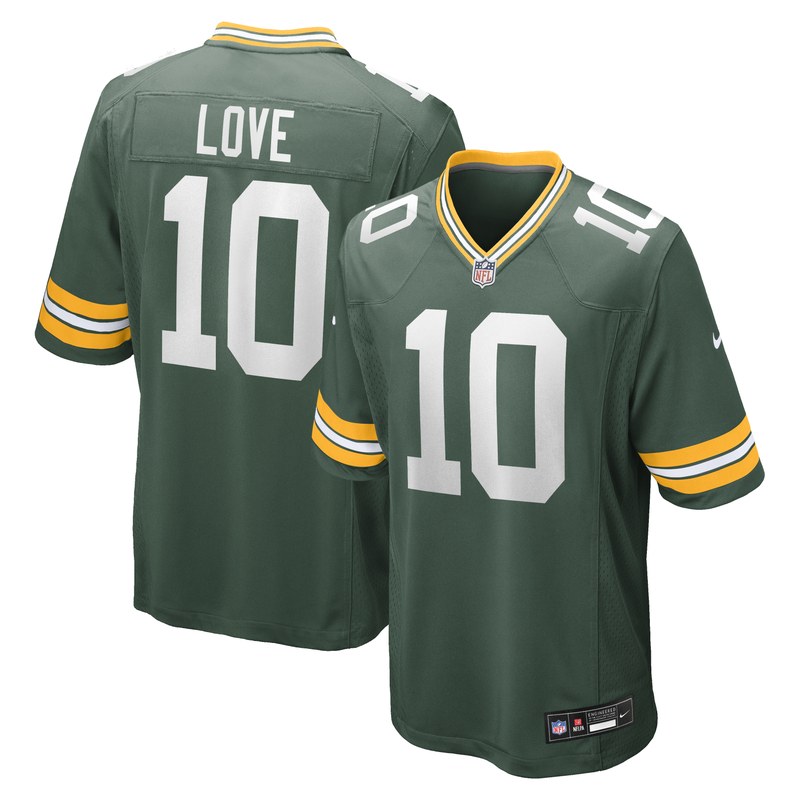
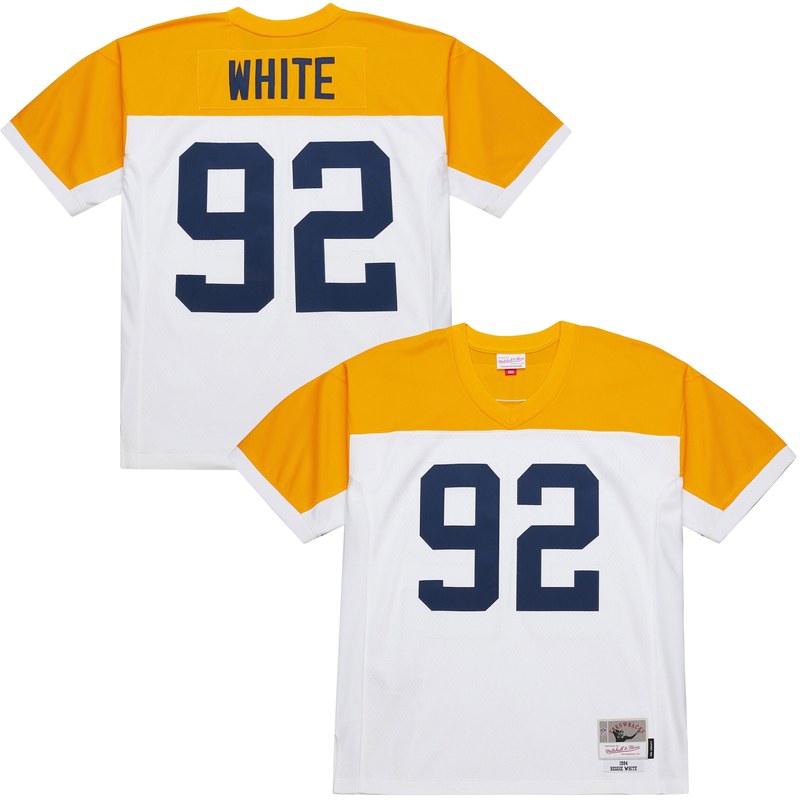
Green Bay Packers jerseys in stock
3 jerseysGreen and gold — the set that has not changed since 1961.
Atlanta: the same three colors, four different answers
Atlanta's colors have been black, red and white from the beginning — with silver added in 1978 — but the club has never settled on which color speaks for it.
The palette itself has a story. The Falcons' first owner, Rankin M. Smith, was a University of Georgia graduate, and the franchise's black-and-red arrived looking conspicuously like the Bulldogs' — a choice that annoyed Georgia Tech supporters across town. The front office's response was a small act of diplomacy: two thin gold stripes were added to the otherwise red helmet, removed again in 1970.
From there, the leading color started moving. The first uniforms paired a red helmet with a black home jersey and white numerals outlined in red. In 1971 the home jersey flipped to red. In 1978 the white pants gave way to silver — arguably the closest the Falcons have ever looked to Georgia — and black facemasks followed in 1984.
1990 was the first genuine pivot. For their 25th season the Falcons put black back in charge and, for the first time in franchise history, wore black helmets. It is the all-black look that later became inseparable from the “Dirty Birds” era, and it is a phrase the club still stamps inside the collar of its current jerseys. A script wordmark and gradient red-to-black sleeves arrived in 1997, then in 2003 came a full redesign: a forward-leaning falcon logo, the team name moved onto the chest, color-blocked sleeves, and a red alternate that took over as the primary in 2004.
The most recent cycle is the most instructive. In 2020 the Falcons went “back to black” — a low-gloss satin black helmet chosen partly to eliminate the reflection thrown off by Mercedes-Benz Stadium's halo video board, an oversized ATL on all three jerseys, and a gradient alternate nicknamed “Rise Up” patterned from the eye of the falcon itself. The set was polarizing, and the club noted in its own launch material that fans — and the team — would love a second red helmet, which the rules did not allow.
Then the rules changed, and so did the design. The 2026 uniform, unveiled in April and worn from this season, returns red to the primary home jersey for the first time in more than two decades — a black helmet, red jersey, white pants and red socks. The oversized ATL is gone: home jerseys read “Falcons,” road jerseys read “Atlanta.” The pants carry a single stripe using every color in the palette in a silver-white-black-red-black-white-silver order, pulled from the original 1966 design, and the brushed-nickel facemask has been simplified to standard silver. The 1966 throwback stays in the closet alongside it.
| Era | Leading color | What the change said |
|---|---|---|
| 1966–70 | Black jersey, red helmet | Georgia's palette, with gold stripes added to placate Georgia Tech |
| 1971–77 | Red jersey, red helmet | The first re-ordering of the same three colors |
| 1978–89 | Red with silver pants | Closest the club has come to its college neighbor |
| 1990–96 | Black jersey, black helmet | A new posture, and the look tied to the “Dirty Birds” |
| 1997–2002 | Black with gradient sleeves | Modernism arrives; the wordmark is rewritten |
| 2003–19 | Red, after a 2004 switch | The tilted falcon logo and a full brand reset |
| 2020–25 | Black with an oversized ATL | City-first branding and a satin black helmet |
| 2026– | Red, with “Falcons” and “Atlanta” | History and legibility brought back to the center |
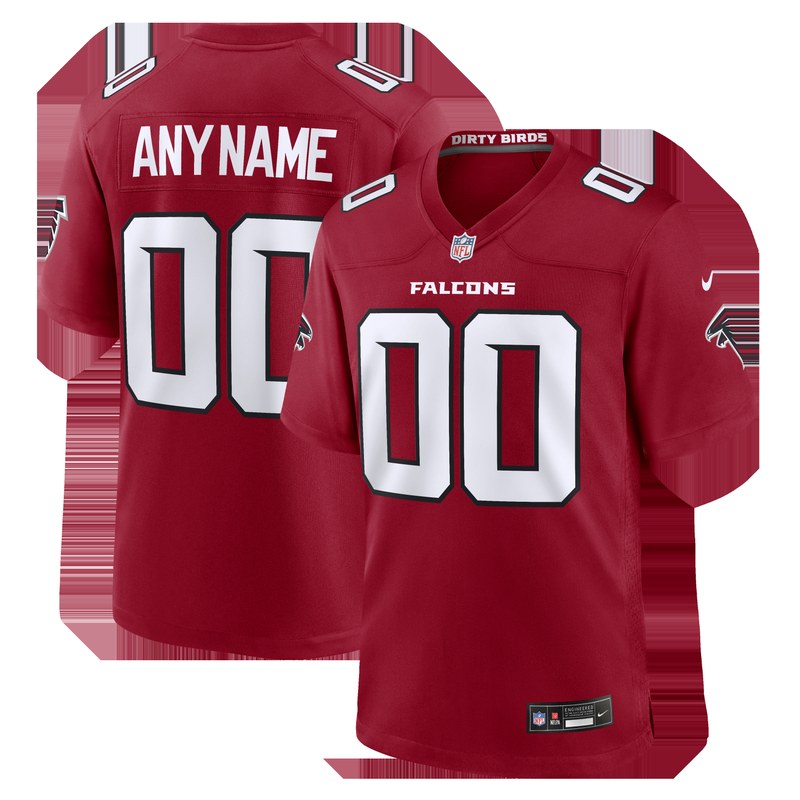
Atlanta Falcons jerseys in stock
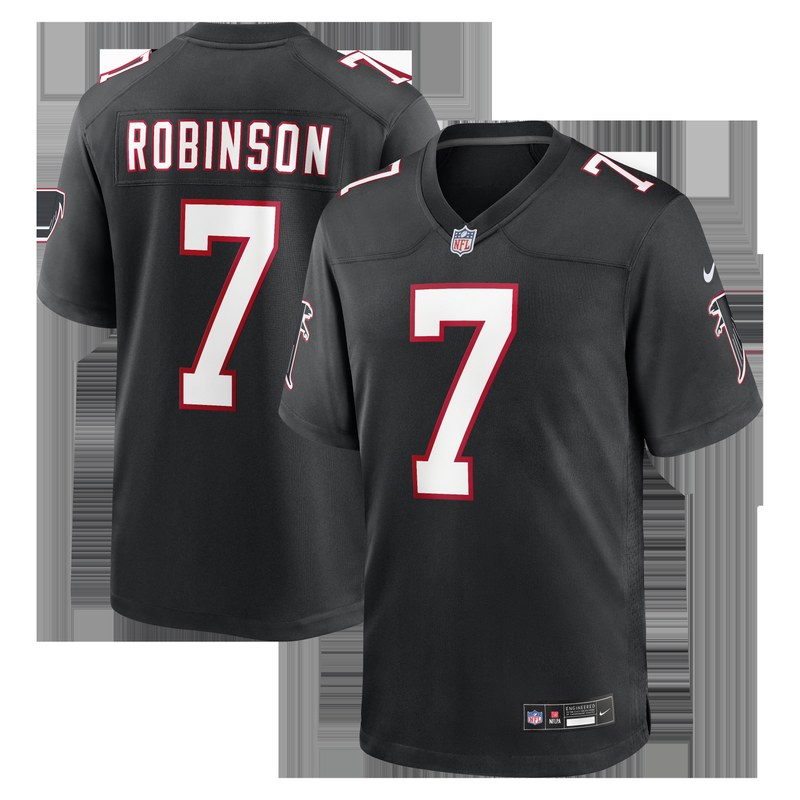
3 jerseysBlack, red and silver — and in 2026, red leads again.
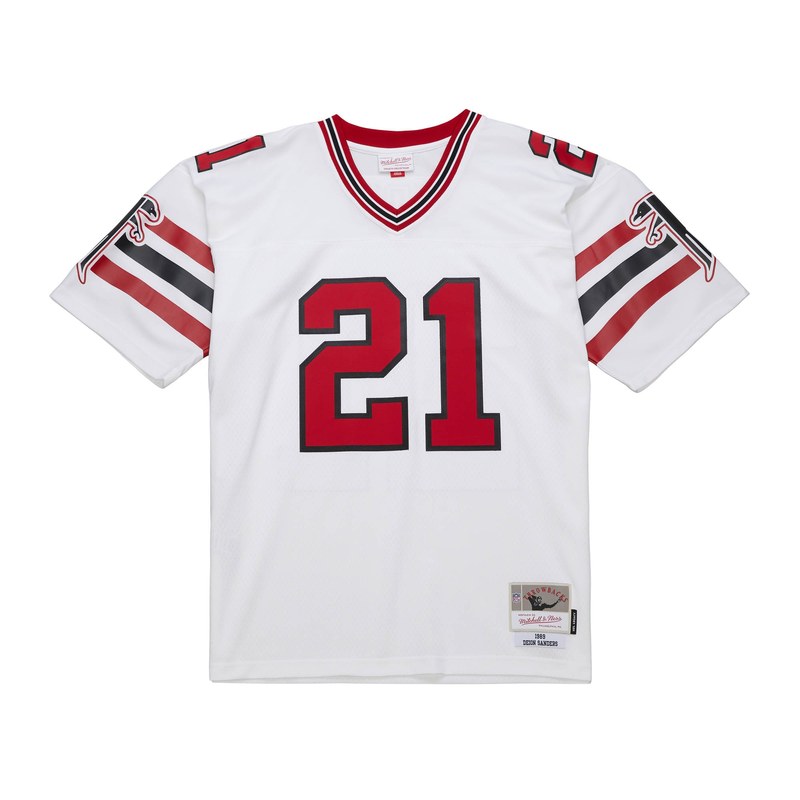
Deion Sanders 1989 Legacy Replica Jersey · White
$72.57 $93.57
Why the same colors can mean four different things
This is the part that makes the two organizations genuinely different rather than merely old and new. Identity in a uniform is not decided by which colors a club chooses — both franchises have used the same palette for decades — but by the proportion in which they are used, and by how permanently that proportion is fixed.
Green Bay's proportion has been locked since 1961. Dark green carries the mass, gold is used only as trim, white supplies relief, and the helmet keeps a single mark.
Atlanta has never locked its proportion. Black and red have swapped the lead role four times, silver has been added, gradient has been used and abandoned, and even the words on the chest have changed twice — from “Falcons” to an oversized “ATL” and now back to a home-and-away split. The colors are a constant; the hierarchy is the message.
One league rule shaped a decade of that message. The NFL restricted clubs to a single helmet from 2013 until the policy was revised for the 2022 season, which made accurate throwbacks impossible for teams whose historic helmet did not match their modern shell. Atlanta's own 2020 launch material wished publicly for a second red helmet. When the restriction lifted, the red helmet returned, which is also why the Falcons' throwback is now one of the more convincing in the league. We take that rule apart in why throwback NFL jerseys continue to stand out.
What tonight's colors are actually saying
A dark green jersey with a gold G against a white road uniform tells you something about both franchises before either takes a snap: one club has spent sixty-five years arguing that its identity is fixed, and the other has spent sixty arguing that its identity is the city it plays for — which is allowed to change its mind. The fabrics underneath have changed plenty; the reasoning behind the colors is described in how NFL jerseys have changed over the decades.
Quick answers
What colors are the Green Bay Packers?
Dark green, gold and white. The Packers wore navy blue and gold from their founding in 1919 until 1950, when new head coach Gene Ronzani switched the club to green. The darker hunter green in use today dates from 1958, and the current combination of green or white jerseys with metallic gold pants was settled soon after Vince Lombardi arrived in 1959.
What does the “G” on the Packers helmet stand for?
Green Bay. The football-shaped G was designed internally — equipment manager Gerald “Dad” Braisher handed the brief to his assistant, St. Norbert College art student John Gordon — and was added to the helmet in 1961. It is the only logo ever to appear on a Packers helmet, and the team's own archivists reject the popular claim that it stands for “greatness.”
What colors do the Atlanta Falcons wear?
Black, red and white, with silver added in 1978. Since 2026 the primary home uniform is a red jersey with a black helmet, white pants and red socks; the road set is a white jersey with a black helmet and a choice of white or black pants.
Have the Falcons ever had black as their main color?
Yes, more than once. Black was the home jersey color from 1966 to 1970, returned as the primary in 1990 along with the franchise's first black helmet, and led the uniform again from 2020 through 2025 before red was restored as the primary in 2026.
Why do NFL road teams wear white?
The home club declares its jersey color and the visiting club must wear a contrasting one, so white becomes the standard road answer to a colored home shirt. Clubs are allowed to wear white at home instead — but Green Bay has done so only twice, in the opening two games of the 1989 season.
Uniform details follow the clubs' own announcements and league records of uniform, helmet and supplier changes. Historical color values and eras are described as documented; the 2026 Falcons set and the current Packers combination are as worn in the 2026 season.