

Throwback & Retro Culture
Every few seasons the NFL rediscovers its own past, and every time it works. The throwback jersey is the rare product that gets better with age, in a sport that otherwise sells only the present — and the reason is not nostalgia. It is design.
Throwbacks are also the clearest window into how NFL uniforms actually work. Because a throwback has to be justified — against a real historical uniform, inside a modern rulebook, on a modern body — it exposes every constraint the league normally hides.
First, the vocabulary
The words get used interchangeably, but they describe different things.
A throwback jersey is a modern garment that reproduces a specific uniform a team actually wore in the past — usually a documented design from a named era. A retro jersey is the looser term: it borrows the visual language of an earlier period without necessarily replicating one exact season. A vintage jersey describes either an original garment from that era or a replica built to look older than it is, depending on who is selling it.
These sit beside two modern categories. An alternate is a third design a team is permitted to add to its rotation; a Color Rush uniform was a monochrome, head-to-toe look created for Thursday night broadcasts between 2015 and 2018. Throwbacks are history; alternates and Color Rush are design.
How the modern throwback was invented in 1994
The league did not set out to create a nostalgia economy. It set out to celebrate its 75th season, and the idea came from the licensing side of the business, borrowed from baseball, which had been letting clubs wear historic and alternate uniforms since the 1970s.
The method was simple and, in retrospect, decisive: the licensing group took photographs from the Pro Football Hall of Fame to team owners and let each club choose the uniform it wanted to reproduce, for one home game and one away game. Across two weekends in the 1994 season, the entire league took the field in the past.
Two things happened that nobody planned for. First, fans responded to the visual shock on television — the jerseys sold far beyond what had been produced, and reported jersey sales rose by more than 30 percent that year. Second, teams started refusing to give the uniforms back. The San Francisco 49ers wore their 1955-inspired throwbacks in week three and four, went back to their regular red and gold, lost 40–8 to Philadelphia, and then asked the league for permission to wear the throwbacks for the rest of the season — and wore them through the Super Bowl.
Before 1994, the past was archival. After 1994, the past was inventory. Almost every alternate-uniform decision the league has made since — the 2002 rule allowing third uniforms, Color Rush in 2015, the alternate-helmet rule in 2022 — descends from that one experiment.
The accuracy problem
The 1994 throwbacks were designed under a hard constraint: teams had one helmet, and a modern hard shell is not the same object as a leather cap. So the league improvised.
Clubs reproducing leather-era uniforms — the Bears, Cardinals, Lions, Packers, Washington and Steelers among them — simply stripped every decal and stripe off their regular helmets. Others wore the wrong color outright: the Buffalo Bills wore red helmets where the historical uniform had white, and the New York Jets wore green instead of white. The Dallas Cowboys wore their then-current helmet with their throwbacks. The 49ers paired 1955-inspired jerseys with modern gold helmets, when the originals were red, and their white throwback carried all-red sleeve stripes instead of the original black-red-black pattern. Every jersey, meanwhile, carried the player's name on the back — a practice that did not become standard in the NFL until around 1970, and mandatory in the late 1970s. Typefaces were, in several cases, "approximate matches at best."
Two clubs got it exactly right: the San Diego Chargers and the Houston Oilers reproduced their 1960 uniforms faithfully, down to the lettering. Both were worn again for the AFL's 50th anniversary celebration in 2009.
This matters to collectors because fidelity is the whole point. A throwback is a claim about history, and it can be graded. Cleveland took the opposite route in 1994 and simply passed its then-current all-white uniform off as a "1964 throwback," since the two happened to look alike.
From two weekends to a permanent second identity
Once the league allowed third uniforms in 2002, throwbacks stopped being a promotion and became a roster slot. The Chargers selected their 1960s throwbacks as their third uniform that year; Dallas adopted accurate 1960s throwbacks as an alternate in 2004, Buffalo in 2005. The Jets had already gone further, returning to a throwback-style look full-time in 1998 in a darker green. Modifications crept in elsewhere: the New York Giants eventually returned to their throwback design full-time, with small changes, in 2000.
Then came the wall. In 2013 the league banned alternate helmets on player-safety grounds, reasoning that one properly fitted helmet per player was safer than two. The rule had a side effect the league almost certainly underestimated: a throwback uniform is usually a color scheme the modern helmet cannot match. The Tampa Bay Buccaneers could not wear their orange-and-white "creamsicle" look properly because the helmet clashed. Neither could the Eagles wear kelly green.
The wall came down in stages. In 2018 the league expanded how many jersey options a club could carry. In 2022, after lobbying from clubs, teams were allowed a second helmet — in a different color, of the same make, model and size, and only paired with Classic, Alternate or Color Rush uniforms, and only if the design was historically accurate or drew a logo from the club's own past. For a great many franchises, that was the moment the throwback became whole.
One footnote worth knowing: outside league-wide promotions, the Kansas City Chiefs are the only club that had not carried an official third uniform as of the 2025 season. Restraint, it turns out, is also a uniform strategy.
Why the old designs still read better
Strip the licensing out and this is a design question, and the answer is structural rather than sentimental.
Older NFL uniforms were built for a viewing distance in a way modern ones are not. Their hierarchy is brutally simple: number first, color second, everything else a trace. They rely on high-contrast, flat color blocking rather than gradients, side panels or engineered textures. Their typography is blocky and geometric, which is why it survives being scaled up onto a modern body. And they carry almost no small-print detail — nothing that turns into visual static at a distance or in a photograph.
That restraint is exactly what makes them work as streetwear. A 1970s-style uniform blown up to modern proportions reads cleanly across a room, which is more than can be said for a contemporary design loaded with tonal-on-tonal detail that only resolves up close.
The material paradox
There is a genuine contradiction at the heart of every modern throwback, and fans notice it even when they can't name it: a jersey designed for wool is being made in a four-way stretch performance knit. The historical garment was heavy, absorbed water and hung loose. The replica is light, dries fast and follows the body.
That mismatch is not a flaw to be fixed. It is the entire proposition — 1960s visual identity, modern industrial capability. It is also why the throwback keeps separating itself in a way a current-season jersey cannot: the design is old enough to be unambiguous, but the object is new enough to be comfortable. You get a clean, legible graphic on a garment that actually functions.
The one-off era, and what replaced it
The league has since explored the opposite instinct — not the past, but the new. Color Rush debuted in 2015 as a collaboration between the NFL and Nike for Thursday night broadcasts, timed to 50 years of televised color, and built around monochrome head-to-toe looks. It produced genuine fan favorites and one of the most-discussed uniform matchups in league history, a red-versus-green Bills–Jets game that highlighted how badly color-vision accessibility had been considered. All 32 clubs had Color Rush uniforms by 2016, and the requirement was dropped before the 2018 season when Thursday night coverage changed hands. The uniforms stayed; the program did not.
Its successor follows the same brief with a tighter filter: the NFL Rivalries series, launched by Nike in 2025 across a staggered multi-year rollout, builds each design around a club's city rather than a season — and takes advantage of the helmet freedom that did not exist a decade ago. Same impulse as a throwback, different source material: find a second identity that doesn't disturb the first.
That is what throwbacks are for, in the end. A franchise only gets one primary look. A throwback lets it hold two versions of itself at once — and it lets fans choose which version of the team they are claiming.
The design logic behind that choice runs through the rest of the uniform: what a jersey is made of and how it has been rebuilt over a century, which we cover in how NFL jerseys have changed over the decades, and the numbers that make a retro design legible in the first place, explained in why NFL jersey numbers matter to football fans.
Authentic throwbacks in stock
4 jerseysNumbers, fonts and trim reproduced from the seasons they came from.
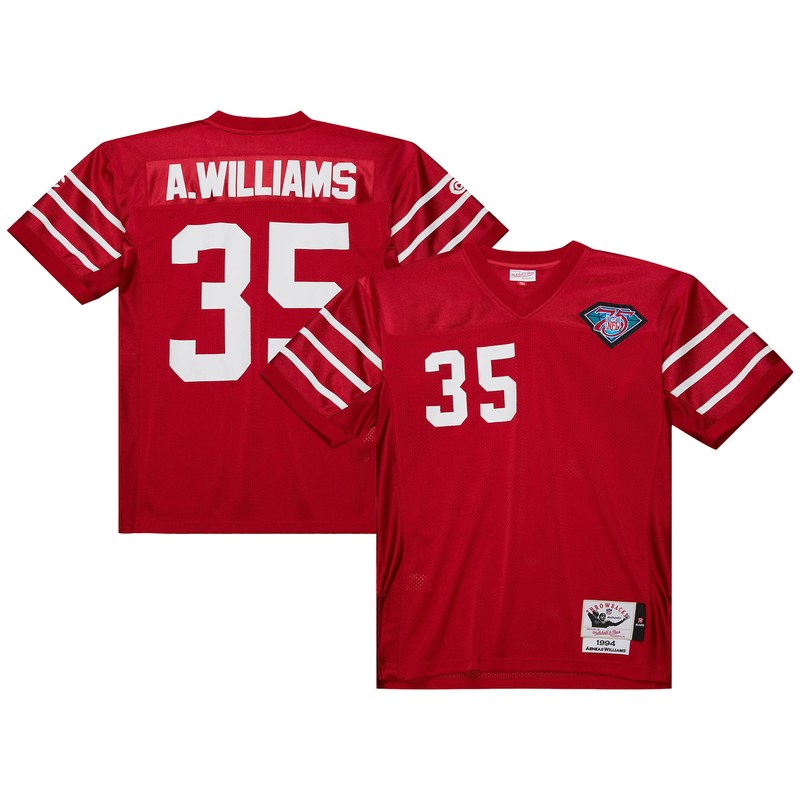
Aeneas Williams 1994 Authentic Throwback Retired Player Jersey · Cardinal
$82.99 $141.57
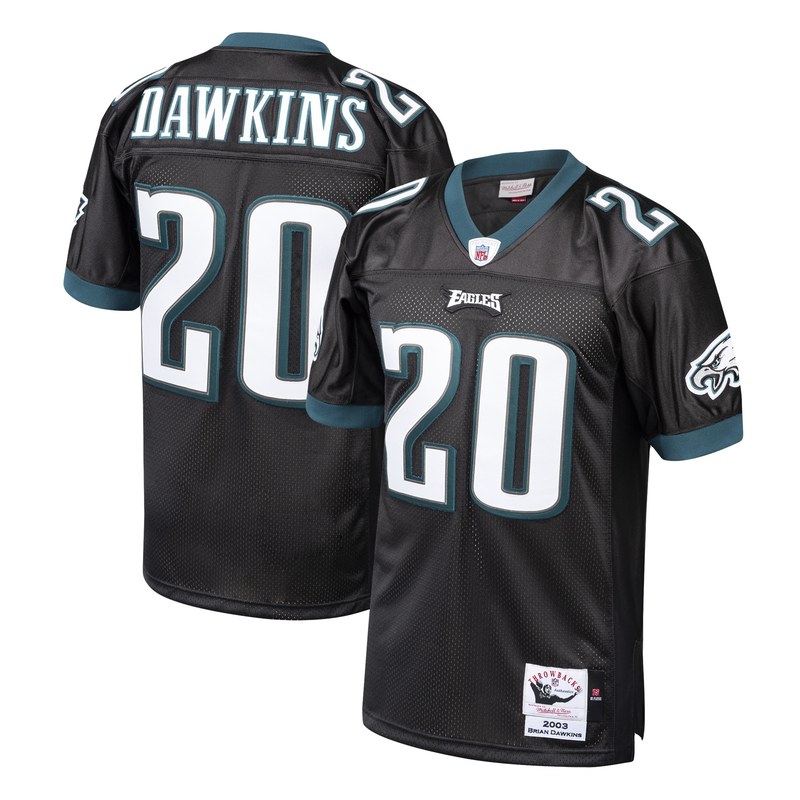
Brian Dawkins 2003 Authentic Throwback Retired Player Jersey · Black
$73.99 $141.57
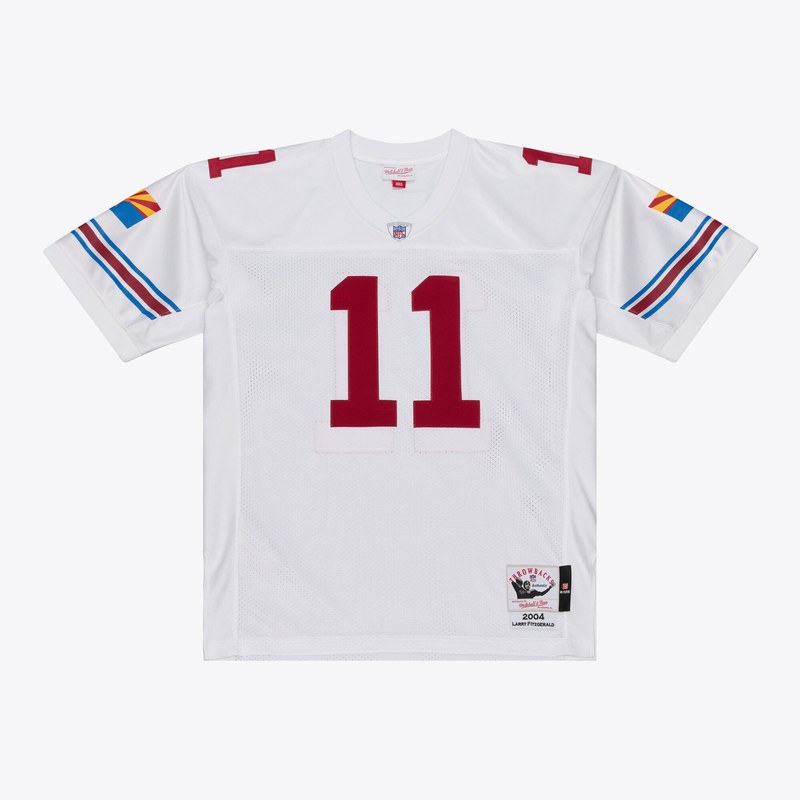
Larry Fitzgerald 2004 Authentic Throwback Jersey · White
$76.99 $141.57
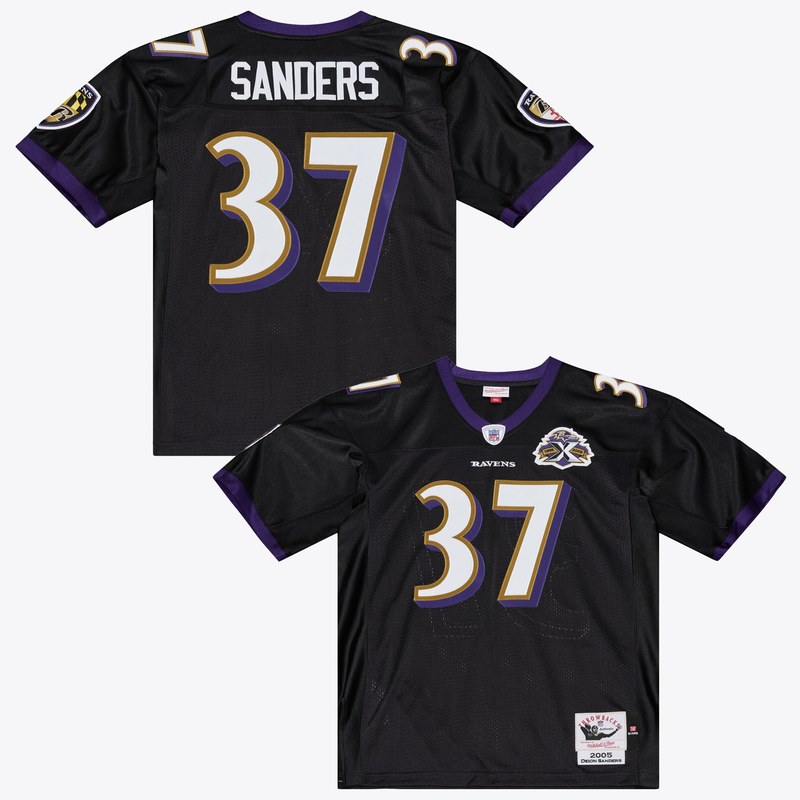
Deion Sanders 2005 Authentic Throwback Jersey · Black
$76.99 $141.57
Quick answers
What is a throwback NFL jersey?
A throwback NFL jersey is a modern jersey that reproduces a uniform a team actually wore in a previous era, usually a documented design from a named season or period. It is distinguished from a generic "retro" look because it makes a specific historical claim — and can therefore be judged on how accurately it matches the original.
What is the difference between a throwback and a retro jersey?
A throwback reproduces one specific historical uniform. "Retro" is broader — it describes any design that borrows the style of an earlier period without replicating a particular season. A vintage jersey usually refers to either an original garment from that era or an intentionally aged replica.
When did the NFL start wearing throwback uniforms?
The league-wide throwback program began in the 1994 season, celebrating the NFL's 75th anniversary, with every club wearing a historic design for a home and an away game. It was driven by the league's licensing division and modeled on baseball's use of historic uniforms.
Why did NFL throwbacks look inaccurate for years?
Mainly helmets. The league restricted teams to a single helmet, so clubs reproducing leather-era uniforms removed decals from modern shells, and several wore helmets in the wrong color entirely. From 2013 to 2021 the one-helmet rule made accuracy impossible for many designs; the rule was lifted for the 2022 season.
Do teams have to wear throwbacks for a whole season?
No. Throwbacks are normally used as an alternate or Classic uniform, worn for selected games. A few clubs have adopted a throwback-style design as their primary uniform — the New York Jets went that route in 1998 and the Giants followed in 2000.
What happened to Color Rush?
Color Rush was a monochrome uniform concept created with Nike for Thursday night games, debuting in 2015 and covering all 32 teams by 2016. The mandatory program ended before the 2018 season, though the uniforms and the idea of a designated one-off look continue in other forms.
Historical details above follow league records of the 1994 throwback program, the NFL's uniform policy changes on alternates and helmets, and the Color Rush and Rivalries programs. Rules described are current as of the 2026 season.