

NFL Jersey History
A football jersey is the only piece of sports equipment a fan can wear to work. That ordinary fact hides an extraordinary design history: a century of wool sweaters, painted numerals, nylon mesh, licensing wars and five-ounce engineered knit, all compressed into a garment that still has to do one simple job — tell you, from forty rows up, exactly who is carrying the ball.
Understanding how the NFL jersey changed means understanding three forces that rarely get mentioned together: materials (what the garment could physically do), television (what viewers could actually see), and merchandise (what fans were willing to buy). Every design decision you can see on a modern jersey — the number size, the sleeve length, the name on the back, the lack of a seam across the shoulders — was pushed into place by one of those three.
Before the modern jersey: wool, leather and improvised numerals
The earliest professional football uniforms were not designed as fan products. They were workwear built to survive a season of mud, and they were made from the materials available to American industry at the time — heavy wool and, on the head, leather. Wool was warm, absorbent and brutally heavy once wet, which is why photographs from the 1920s and 1930s show players who look bulkier than their listed weights.
Numbers arrived slowly and unevenly. Through the 1920s, rosters were capped at twenty-two players, so numbers rarely climbed much past the mid-twenties, and a player's number had almost no relationship to his position. One famous exception proves the point: halfback Red Grange wore 77 for the Chicago Bears, a number no modern halfback could be issued.
The numbering that eventually became standard grew out of the offense, not the roster. When teams ran the single wing, backs and linemen occupied fixed spots, and as those teams shifted to the T-formation through the 1930s and 1940s, the numbers traveled with the positions. Backs took the 10s through 40s; the offensive line took the 50s through 80s. It was a convention borrowed from college football and applied in the pros only informally.
1952: the merger that forced a real system
The modern numbering rule has a very specific origin, and it is not a design story at all — it is a paperwork problem. The All-America Football Conference used a completely different scheme (quarterbacks in the 60s, ends in the 50s, centers in the 20s). When the AAFC merged into the NFL in 1950, the combined league was suddenly full of conflicting numbers, so in 1952 the NFL imposed a mandatory, position-based system.
The cost fell on established stars. Center Otto Graham moved from 60 to 14. Quarterback Norm Van Brocklin went from 25 to 11. Fullback Marion Motley went from 76 to 36. End Tom Fears went from 55 to 80. Men who had built a career around a number had to hand it back.
Two things followed that still shape jerseys today. First, last names on the back spread through the 1960s and became standard around 1970 — and mandatory in the late 1970s — giving the jersey a second identification layer beyond the number. Second, "TV numbers" appeared on sleeves and shoulders, because broadcasters and viewers needed to read a player from a camera angle that showed his back three-quarters on. As of the 2018 season, shoulder numbers are mandatory; helmet and pants numbers remain optional. The Cincinnati Bengals were the last team to regularly skip TV numbers, in 1980.
A jersey is engineered for a viewing distance, not a fitting room. Almost everything that looks like style on a football uniform started as a legibility problem.
The synthetic turn: from cotton to engineered knit
Post-war chemistry changed the garment. Wool and heavy cotton gave way to synthetic blends and open-weave mesh that dried faster and weighed less, and the jersey stopped being a sweater and became a piece of equipment. Color got brighter because the fabrics took dye differently. Typefaces got blockier because embroidery machines could stitch them cleanly.
The visual language most fans now think of as "classic NFL" is largely a product of the 1960s and 1970s: bold sleeve striping, high-contrast color blocking, a number doing almost all the work. It was a period when a team's identity could be read at a glance, and it is the period the league keeps returning to.
In 1973 the league tightened the number ranges by position — the framework that survives today, with amendments in 2004, 2015, 2021 and 2023. You can read the current map in our breakdown of why NFL jersey numbers matter so much to fans.
The retail revolution: the jersey leaves the sideline
Until the late 1980s, NFL teams signed their own apparel deals, and the sideline looked like a trade show. Wilson, Champion, Russell Athletic, Starter, Apex, Logo Athletic, Puma, Adidas and Nike all outfitted clubs at various points. The result was visual variety and a growing consumer market: for the first time, the jersey a fan bought in a store was genuinely close to what a player wore.
Then came the deal that ended all of that. In 2000 Reebok signed an exclusive, roughly ten-year, quarter-billion-dollar agreement to outfit every team, and from the 2002 season the entire league wore one supplier. Competing logos could draw a fine.
Reebok's tenure left two fingerprints that are still visible. At players' request — tight sleeves and holding calls were a running complaint of the era — sleeves were shortened across the league, and the cut was generally tightened. The most quoted example is the Indianapolis Colts: their shoulder stripes, which had once run from the top of the shoulder down and under the arm, were truncated to the shoulder itself.
The same period legalised the alternate jersey. From 2002 teams could wear a third design, and clubs reached straight for their own history: the San Diego Chargers adopted their 1960s throwbacks as a third uniform.
2012 onward: the jersey as engineering
Nike took over as the league's exclusive supplier for the 2012 season and pushed the garment further from apparel and closer to equipment. The clearest example is the Vapor Untouchable chassis: a continuous knit that eliminates the traditional shoulder seams, brings the jersey down to roughly five ounces, and uses four-way stretch so the fabric sits tight against the pads instead of hanging loose — a jersey engineered, quite literally, to be harder to grab.
Two side effects matter to fans. The silhouette narrowed, ending the oversized, boxy era. And the palette widened, because a lighter fabric plus color-fast dye makes high-contrast alternates practical — the same technical freedom that later produced the one-off, single-season alternate and "Color Rush" jersey.
Nike has held the contract through at least the 2027 season, with bidding on the next apparel deal reported to be open as of 2026. Whatever comes next, the direction of travel has been consistent for a century: lighter, tighter, brighter, more engineered.
What actually hasn't changed
Strip away the fabric and the licensing, and the jersey still carries the same three pieces of information it carried in 1952: a color that identifies a city, a number that identifies a man, and — since roughly 1970 — a name that confirms it. Every redesign in league history has been an argument about those three things and how loudly to say them.
That is also why the past keeps winning. The 1994 throwback experiment, mounted for the league's 75th anniversary, was expected to be a novelty; instead jersey sales rose by more than 30 percent that season, and the league discovered that retro designs weren't nostalgia — they were a product line. We take that story apart separately in why throwback NFL jerseys continue to stand out.
Four eras, four jerseys in stock
4 jerseysCut, fabric and trim from four different decades — all on the shelf today.
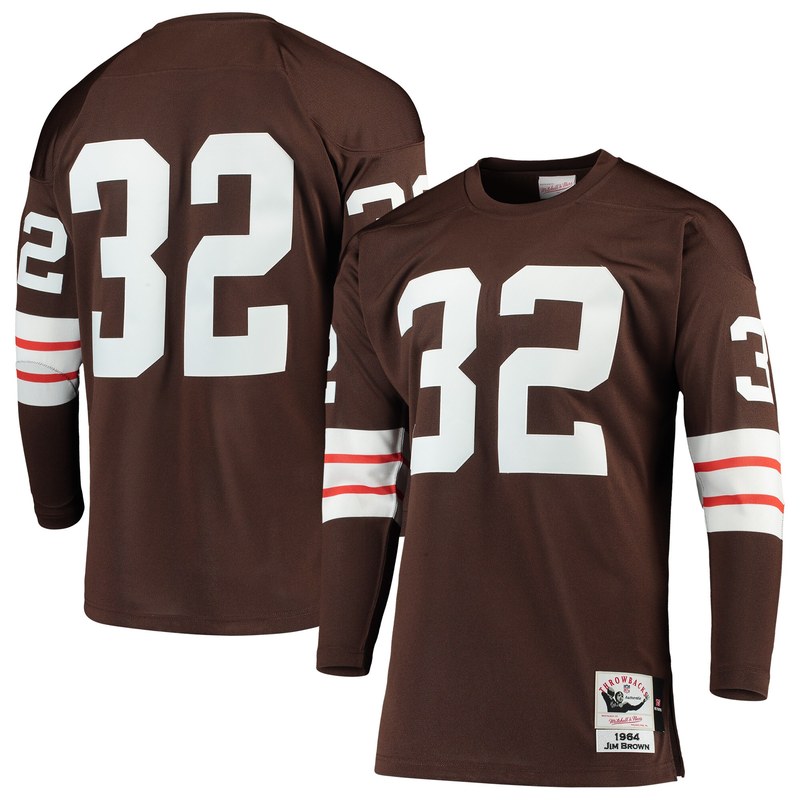
Jim Brown 1964 Authentic Throwback Retired Player Jersey · Brown
$77.99 $141.57
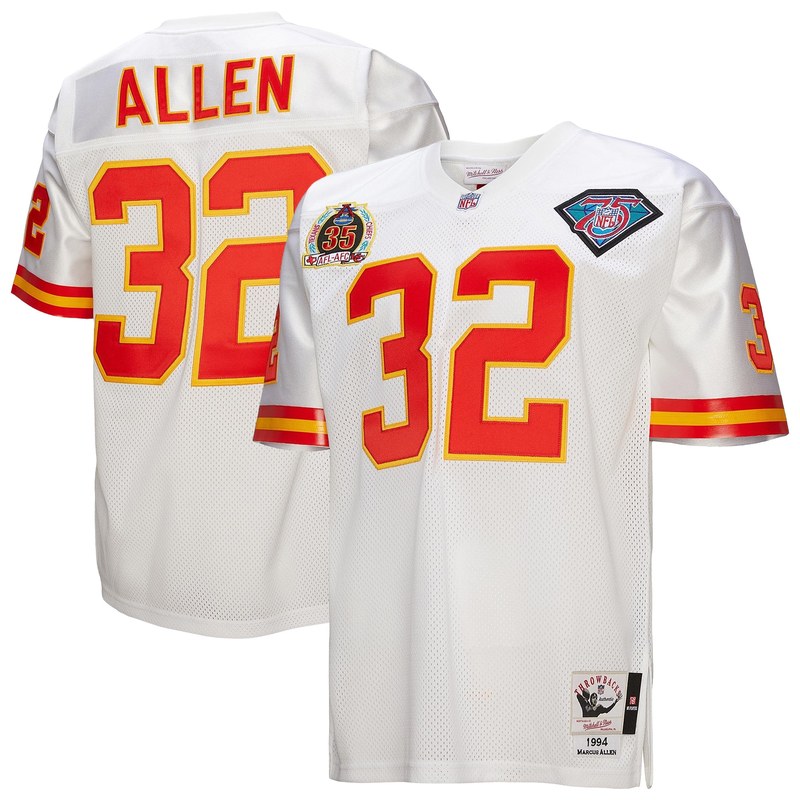
Marcus Allen 1994 Authentic Throwback Retired Player Jersey · White
$84.99 $141.57
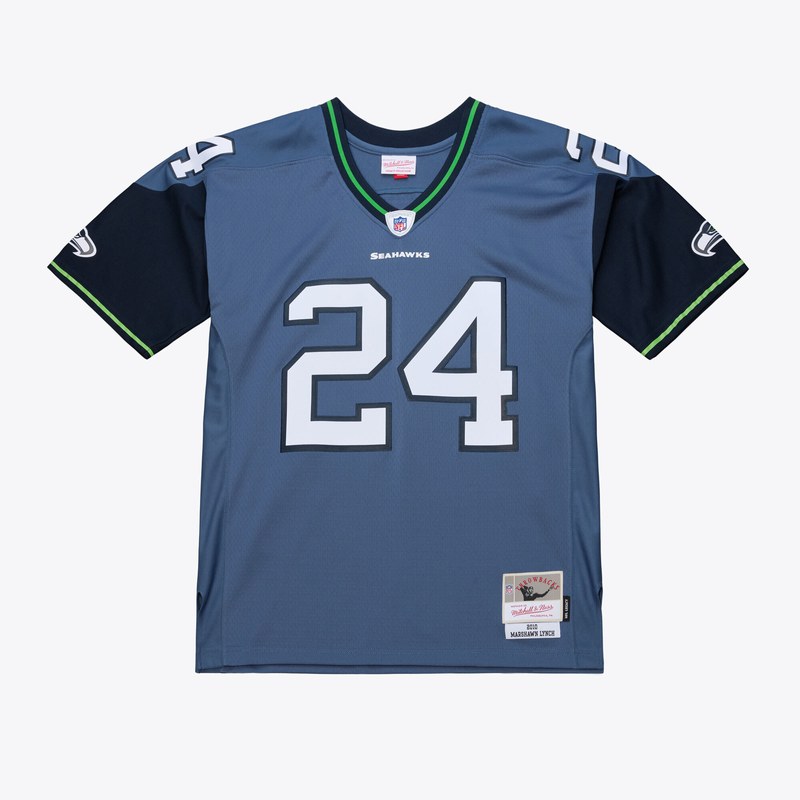
Marshawn Lynch 2010 Legacy Throwback Replica Jersey · Blue
$72.57 $93.57
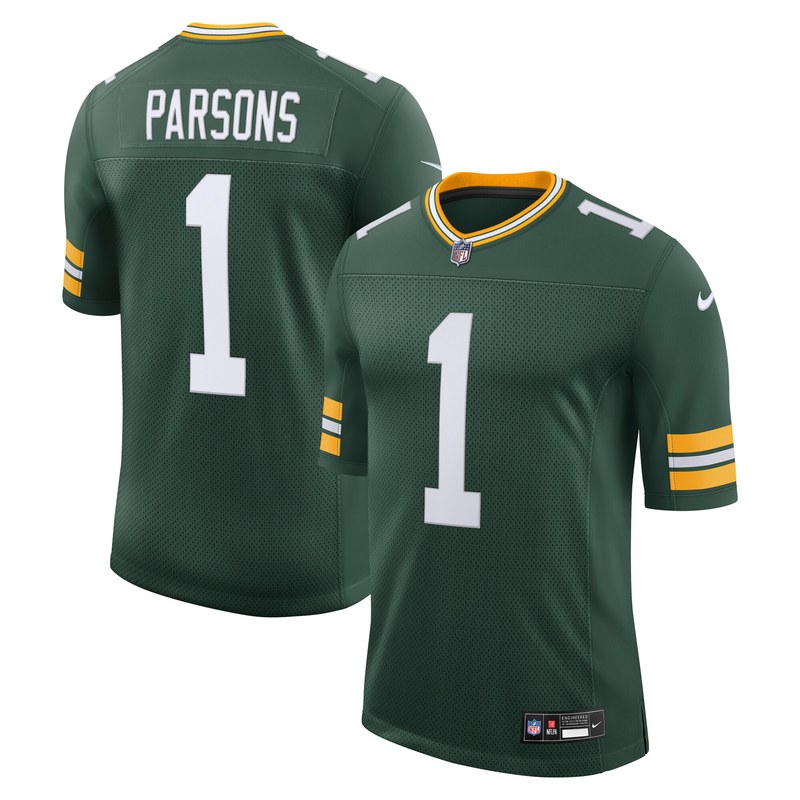
Micah Parsons #11 Vapor Untouchable Stitched Limited Jersey · Green
$83.57 $116.57
Quick answers
When did NFL jerseys start having numbers?
Teams began numbering players in the 1920s as the league formalized, but it was inconsistent and had little to do with position. A mandatory, position-based league-wide system arrived in 1952, after the AAFC merger created conflicts, and was tightened into the modern structure in 1973.
When did last names appear on the back of NFL jerseys?
The practice spread through the 1960s, became standard around 1970, and was mandatory in the NFL by the late 1970s. Crucially, names stayed on even when teams wore throwback uniforms from eras before the rule existed.
Why did NFL sleeves get shorter?
Players asked for it. Long, loose sleeves were easy for defenders to grab, and a decade of players taping sleeves tight led the league's suppliers to shorten them officially — a change that became league-wide in the early 2000s and permanently altered several teams' signature shoulder striping.
Did every NFL team have the same jersey manufacturer before 2002?
No. Teams negotiated individually, so a single season could feature Wilson, Champion, Starter, Puma, Nike, Adidas and Russell Athletic on different sidelines. Exclusive single-supplier deals — Reebok from 2002, Nike from 2012 — are a modern arrangement.
How much does a modern NFL jersey weigh?
Current engineered football jerseys sit in the region of five ounces for the jersey itself, achieved by removing seams and using four-way stretch knit rather than cut-and-sew panels. For comparison, the wool garments of the 1920s absorbed water and became dramatically heavier during play.
Historical details in this article follow the NFL's published playing rules and league records of uniform and licensing changes. Current rules and commercial arrangements are noted as of the 2026 season and can change.